Skip to product information
1 of 4

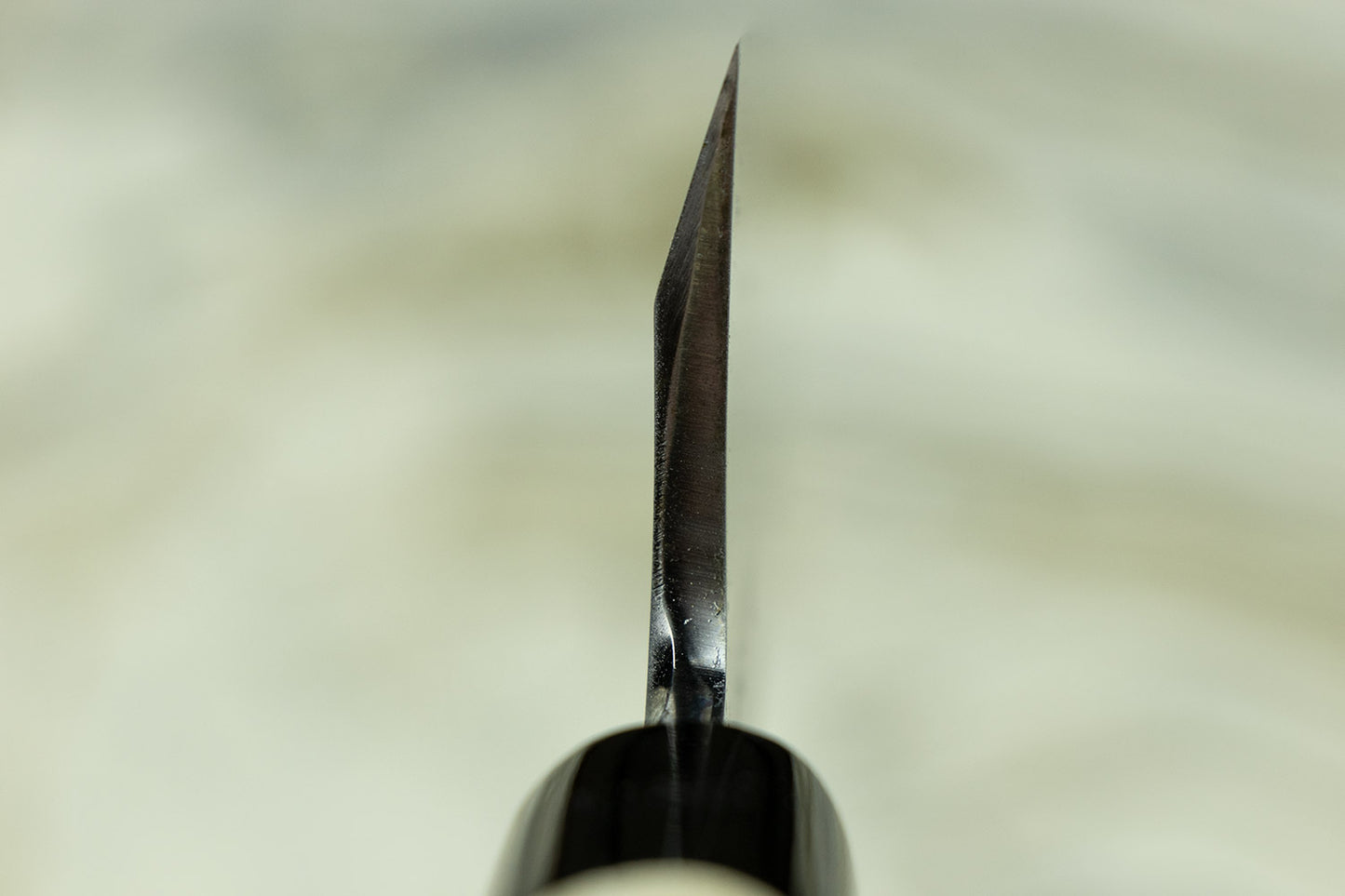
Sakai Takayuki Tokujo Shirogami Garasuki 180mm

Sakai Takayuki Tokujo Shirogami Garasuki 180mm

Regular price $500.00 CAD
Regular price Sale price $500.00 CAD
Sale Sold out

$3 Shipping on orders over $100 within Canada. ?

Order

Place your order today and we'll prepare it for shipment

Your order will be shipped on this date

Arrives

About the Shape -The Garasuki is a Japanese style of boning knife. Originally designed for poultry and small animals like rabbit, it excels for many larger butchering and fish filleting work or thanksgiving turkey! It is typically larger than a honesuki, and often has a single-bevel edge for added sharpness. You don't want to force this knife through bone, but it's perfect for cutting through cartilage and tendons.

About Sakai Takayuki -Sakai Takayuki is well-known as the largest knife maker in Sakai. The company hosts a number of blacksmiths and craftsmen who work together to create a huge array of knives. Although the Sakai region traditionally specializes in single-bevel blades, Sakai Takayuki makes many different shapes.

Shape Garasuki
Also know as? You could also call it a depending on what part of Japan you are in.
Maintenance Level High
Rust Prone ⓘ This knife can rust, click to learn more.
Blade Length 180 mm |
Blade Height 50.2 mm
Thickness 5.6 mm
Weight 239 g
Steel Type Shirogami #2 (White Carbon Steel) With Carbon Steel Cladding
Rockwell Hardness 62 - 63
Edge/Bevel Single Bevel - Right Bias
Handle Wa (Japanese) Handle - Octagon Magnolia Water Buffalo Horn Collar
Blacksmith Kenji Togashi
Made in Sakai, Osaka, Japan
Brand

A note about measurements: Knife edge length is shorter than stated, as Sakai knives are measured from the front of the handle to the tip. Additionally, some knives feature a small 'machi' gap between the handle and blade.


A NOTE ABOUT RUST  

Carbon steel is an awesome material to make knives out of. It’s easy to get sharp and stays sharp a very long time. But this comes with a trade-off; It will rust if you let it. To  avoid “bad” rust (orange rust) Wipe the knife dry with a dry cloth after use. Over time, the  blade will begin to protect itself with an oxide layer (grey to dark grey “good” rust),  this will slow the reaction time but not inhibit the rust entirely. Maintain the good  habit of drying off your knife.  

USE  

• Only cut food you can bite through with this knife. Hard foods can chip the blade. No olive pits, bones,  lobster shells, woody stems or parmesan rinds. Cutting frozen food is especially bad  because the cold will make hard steel even more brittle. If you wouldn’t chew it with  your own teeth, don’t cut it.  

• Your cutting surface is the biggest culprit of dulling your knife. Use wood. End  grain wood is especially good. Plastic can be fine too, but certainly not glass,  granite or bamboo

• The edge of your knife works best sliding forwards or backwards. Scraping the  knife edge sideways will dull or damage the edge. Instead, use the spine of the knife to move foods across the cutting board. Do not twist the edge or pry with the edge, this is the worst screwdriver you ever bought and these motions will certainly  damage the edge. Listen to the knife! If you can hear the edge making a “tink”  sound on the cutting board, change what you are doing.  

CLEANING  

• After use, wash the knife by hand with regular dish soap, rinse with hot water  and dry by hand immediately. Dishwashers are very bad for knives.  

• Wood handles may dry out over time and exposure to water. Simply treat them  with some food safe mineral oil or beeswax.  

• If you see orange rust, remove it. The scrubby side of a sponge can do the trick.  If it’s still not coming off try baking soda and water mixed into a paste or a product  called Barkeeper’s Friend.  

STORING  

• Protect the edge; for your safety and to avoid edge damage. A simple blade cover  will do the trick if you keep knives in a drawer or travel case. 

• A convenient wall magnet made with wood is a great way to show off your knives.  Be sure to put it back spine first, then roll it onto the blade face. This will keep the  edge from contacting the wood first.  

• The good-ol’ counter top block can keep knives at the ready and protected. So can  drawer inserts. Whatever the method, keep the edge from touching anything else. 

Shipping and Returns

We aim to ship your order within 1 business day at Knifewear, if there is a hold up, we'll aim to let you know and give you a timeline.

We offer $3 shipping on orders over $100* anywhere in Canada and $200* to customers in the USA. We ship worldwide, and offer up to the minute rates from our shipping partner DHL.

*Konro Grills and some other larger items are excluded from the free shipping offer.

How do I make a return on an online order?
No worries, we've got you sorted. Head over to https://knifewear.mom/returns and follow the prompts. 

Can I pick up my order Curbside / At the store?
Absolutely, as long as all the items you are looking for are in stock at the location you want to pickup from, you'll be able to select that at the checkout. If one or more items aren't at your preferred location we are happy to ship it to you. 

Request Additional Info

View full details
Great customer service
large Selection
Satisfaction Guaranteed

Overall rating: 4.0 / 5 from 2 reviews.

AI Generated Review Summary

Summary topics

Review topics: ["knife"].

Review highlights

Reviews

Saki Takayuki Garasuki

"A beautiful traditional Japanese knife that’s not much good for anything but processing geese or turkeys and for that it’s magic! Pretty sharp out of the box but raised to screaming sharp with a dozen passes on a leather strop. Flat kasumi blade road and polished hamaguri edge. My knife deviated from the norm by having a very shallow to almost flat Ura that will make future burr removal sharpening stone scratches more apparent. The joint between Ho wood handle and buffalo horn collar was also very apparent and obnoxious for a knife at this price point. The polished blade body also had a couple of rust pits that looked like dried water spots. Didn’t affect performance but didn’t help aesthetics either. Goose or turkey blood is very corrosive and can pit soft iron or white steel in minutes, as such, this knife is better for breaking down already dressed birds. I also tried it on charcuterie and cheese with the blade tending to wander. Definitely easier with a Bunka or Santoku which may be less expensive. My overall impression was of a once brilliant knife line that had dimmed due to lack of attention to detail. It was a good tool but a poor specimen. In fairness, I had the opportunity for an exchange but didn’t due to low stock and holiday hectics."

Thomas K. (3/5)

Question

"Can this knife be use for lefties??"

Jesse (5/5)

Q&A

Recently Viewed